Castelo Borges
From 3 hours to 15 minutes: how an agent became the document brain of a 30-year-old property management firm
What happened here
Castelo Borges is a property management firm in Fortaleza, Brazil, operating since 1994. The engagement started as a full-company diagnostic: area by area, mapping where AI could actually solve a real problem. Generating assembly minutes turned out to be the most painful one. Three hours of repetitive work bouncing between three different tools after every meeting.
We built Castelo, an agent that takes the audio, partitions it, transcribes while identifying each speaker, and delivers the minutes in legal format or as an executive summary. Around it we wired the ERP integration, Google Drive governance, and automatic generation of the notices that lead to the assemblies themselves.
A 30-year-old firm that wanted real reduction, not pilots
Castelo Borges isn't a startup. It's part of a group with more than three decades in Fortaleza, running condominium management, security, doorman services, and outsourced labor. The kind of company where the process is already settled and has worked for decades.
Leadership wanted to understand where AI would actually reduce work. Not in a pilot project, but in the day-to-day. Where person-hours were being burned on something repetitive.
We ran a complete diagnostic, area by area. And I believe in one thing: learning has to be tied to practice. So instead of delivering a report and walking away, each strategic person at the firm picked a project. Something taking real weekly time that could be automated.
My rule: if you do something repetitive that takes more than an hour a week, it should be automated.
Three hours of orchestrating three tools just to write one document
The biggest opportunity surfaced inside the document workflow, and specifically in generating assembly minutes. Every condominium assembly has to become minutes, in legal format, following the bylaws.
Before we came in, the process worked like this. Someone recorded the meeting audio. That audio went through three different tools. One to cut it into smaller chunks. Another to transcribe. Another to stitch the transcripts back together. At the end, the result went into ChatGPT to be turned into minutes. There was already AI at the end of the pipeline. The workflow was still grinding work.
Average time was three hours or more per person after each meeting. Multiply that by dozens of condos, by several assemblies a year, by more than one person involved. Person-months were burning on tool orchestration, not on judgment.
And the work actually started before the assembly. Every set of minutes begins with a notice, the document defining what will be discussed. That notice has to follow the bylaws of that specific condo. Another repetitive piece nobody was tackling with method.
From a chain of tools to a single agent in production
First: map the actual pipeline
Why three tools? Because nobody had ever sat down to draw the flow end to end. Once you draw it, the truth shows up. It is a linear pipeline: raw audio, audio fragments, speaker-tagged transcription, structured minutes. One agent can own all of it.
Second: rapid proof of concept
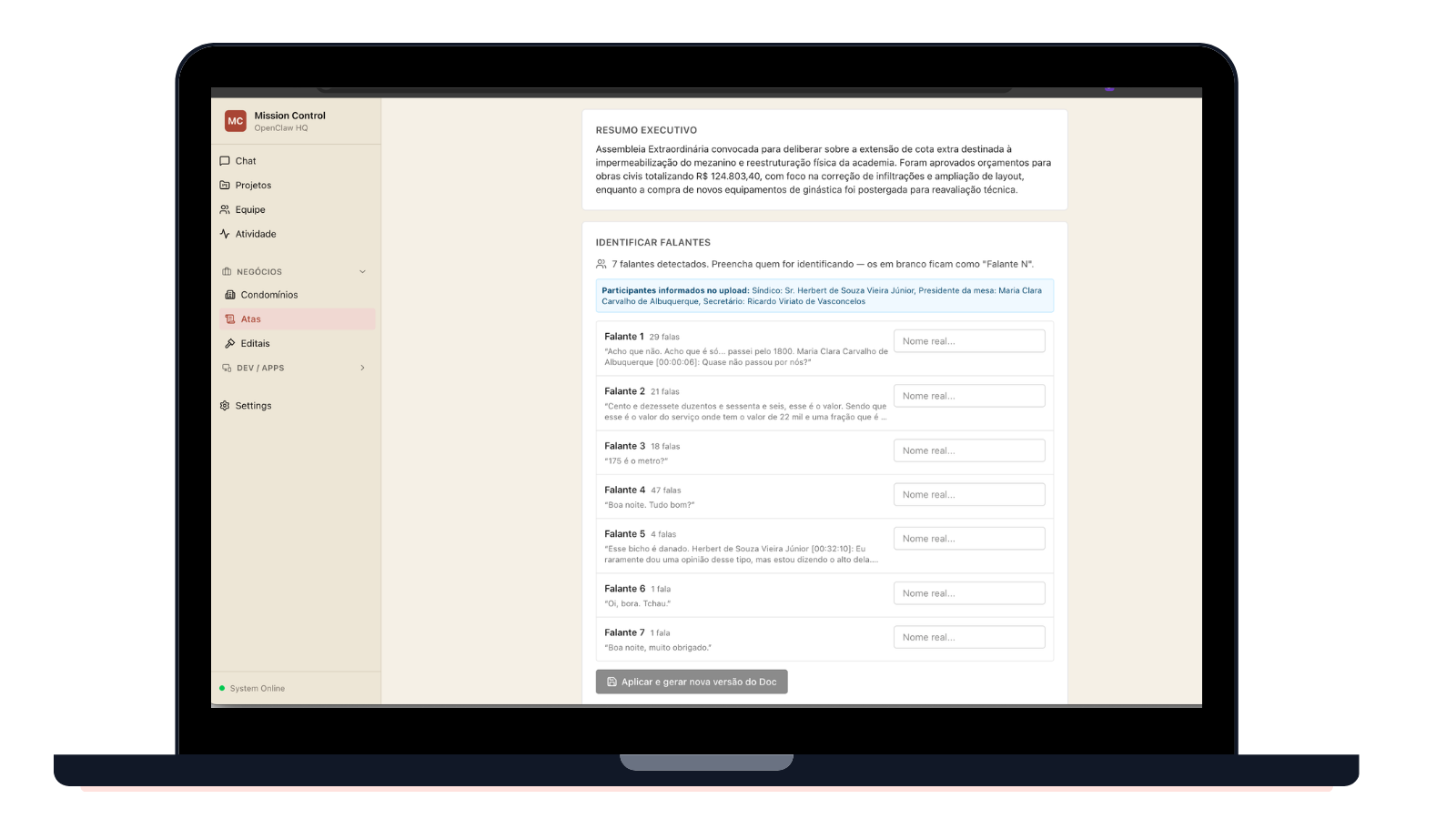
We grabbed a real assembly recording and validated the partitioning and speaker-diarized transcription. On a typical assembly, the system detects around seven distinct speakers and offers them up for naming. The team only has to associate each one with the chair, secretary, manager, and residents. We kept ChatGPT only at the end, just enough to confirm that the bottleneck really was the manual orchestration. It was.
Third: a single agent in production
With validation in hand, we built Castelo. One agent that owns the entire pipeline, hosted on Mission Control (the same operational layer the Vão Livre case runs on), reachable from Discord, and wired into Google Drive and the company's ERP. The team talks to Castelo by mentioning it in a channel. Castelo narrates each step as it runs.
Fourth: connect the brain to the ERP
Castelo Borges runs on Superlógica as its ERP. Integrating with it unlocked everything that came after. Castelo now knows the bylaws of every condominium, who the residents are, who the building manager is, and who is a tenant. From that point on, generating notices, sending resident notifications, any official communication came out compliant by default.
Fifth: govern the Drive
Every document generated lands in the right place, with the right name, properly versioned. Google Drive, which used to be a loose folder with each condo's history dumped inside, became a system the agent itself organizes.
One agent, three deliverables
We built a single agent. The client gave it a name: Castelo. It has a clear personality inside the operation.
Castelo
Takes the assembly audio. Partitions it into transcribable blocks. Identifies each speaker. Builds the minutes in legal format or as an executive summary, depending on the use case. The document lands in Drive, gets indexed, and becomes a permanent part of the firm's knowledge. Ask about any minutes, any condo, any period. Castelo answers.
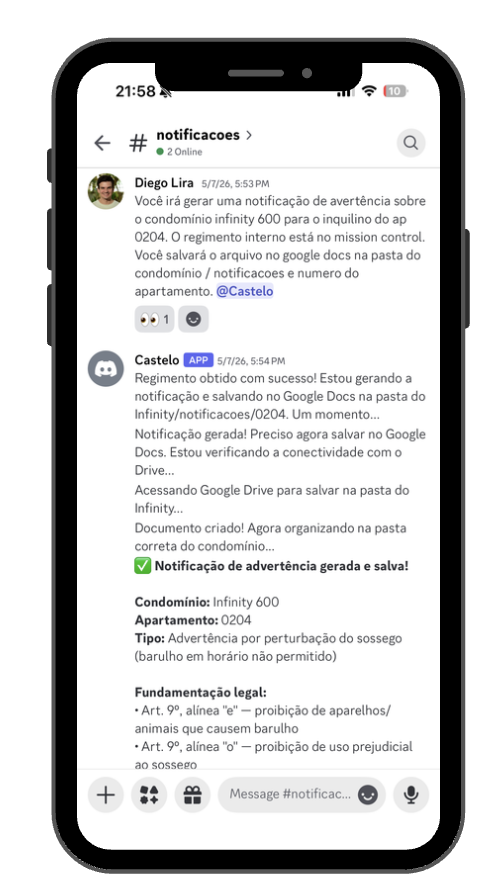
The same agent owns three flows in the operation.
Notices before each assembly
Castelo already knows the bylaws of every condo through Superlógica. From that, it drafts the notice, compliant with the rules of that specific building.
Resident notifications by the book
Fines, announcements, late-payment notices, any official communication goes out within what the bylaws allow, fully traceable.
Drive under governance
The agent organizes, maintains, and updates Drive. Every document is born in the right place, with the right name, in the right condo folder.
Drive layout the agent maintains. One folder per condo, the bylaws indexed at the root, every artifact filed by year and type.
Replacing three tools with one was the start. What really changed is that the firm's institutional memory stopped being a folder on Drive. It became a system that answers.
From 3 hours to 15 minutes. Per meeting.
The person who used to spend three hours after every meeting now spends fifteen minutes, and most of that is review, not execution. The rest is freed up for work that actually requires human judgment.
Notices go out before the assembly, aligned to the condo's bylaws, without line-by-line legal review. Resident notifications fire within the rules of each set of bylaws, fully traceable.
And what used to be a loose folder on Drive became a source of truth. Ask Castelo about any minutes, any condo, any period. The answer comes back with the original passage attached.
Does your company have similar processes?
If anyone on your team spends more than an hour a week on repetitive work, it probably can be automated. Getting started is simpler than it looks, and the results show up fast.