Vão Livre
From 50 minutes to 5: how autonomous agents transformed a construction firm's legal department
What happened here
Vão Livre is a metal-structures construction firm based in Paraíba, Brazil, operating since 1994. The engagement started as a full-company diagnostic: area by area, mapping where AI could solve real problems. The legal department surfaced the most opportunities. The result: subcontracting contracts that took 50 minutes are now generated in 5, sent automatically for digital signature.
A traditional construction firm wanting to evolve
Vão Livre isn't a startup. It's a 30-plus-year-old construction company specialized in metal structures: buildings, hospitals, shopping centers, industrial warehouses, oil and gas facilities. The kind of company where things work the way they've always worked.
But leadership wanted to understand where technology could help. Not with vague promises of digital transformation, but with concrete results in the day-to-day of the people working there.
We ran a complete diagnostic, area by area. And I believe in one thing: learning has to be tied to practice. So instead of delivering a report and walking away, each strategic person at the company picked a project. Something consuming significant weekly time that could be automated.
My rule: if you do something repetitive that takes more than an hour a week, it should be automated.
50 minutes to generate a contract that always follows the same pattern
The area that surfaced the most ideas was legal. Few tech innovations there, but high awareness that the work was repetitive.
In construction there's something called subcontracting. You're on a jobsite and you need to hire other companies to perform specific services. Each subcontract requires a contract. And those contracts follow a pattern. What changes is the billing, the scope of service, the supplier's data.
Sounds simple. But in practice, a senior legal team member (not a junior) spent an average of 50 minutes per contract. Why? Because the process meant fetching data from the ERP, looking up supplier info online, waiting for the request to arrive from engineering, and coordinating between several people. It was orchestration work, not legal expertise.
And the requests came in via WhatsApp or email, with no standard, no traceability. The field engineer would send a message asking for the contract, and a back-and-forth race would start between legal, engineering, and the supplier.
From proof of concept to agents in production
First: understand how things already worked
We mapped the process and noticed something important: engineers already used written text (WhatsApp, email) to request contracts. That meant the AI interface didn't have to feel foreign. Written form was already natural to them.
Second: rapid proof of concept
We built a simple flow with Make and n8n to validate the idea. It wasn't meant to be the final solution, just a way to see whether it made sense and how people would react. The first results were encouraging. More importantly, it served as on-the-job learning for the legal team, who were building alongside me. They saw what was possible.
Third: production with autonomous agents
With validation in hand, we moved to the real solution. We used OpenClaw as the automation engine, and on top of it I built Mission Control. That's my platform where autonomous agents live. Think of it like a Trello: you see everything happening, every step, every move. But the agents make those moves on their own.
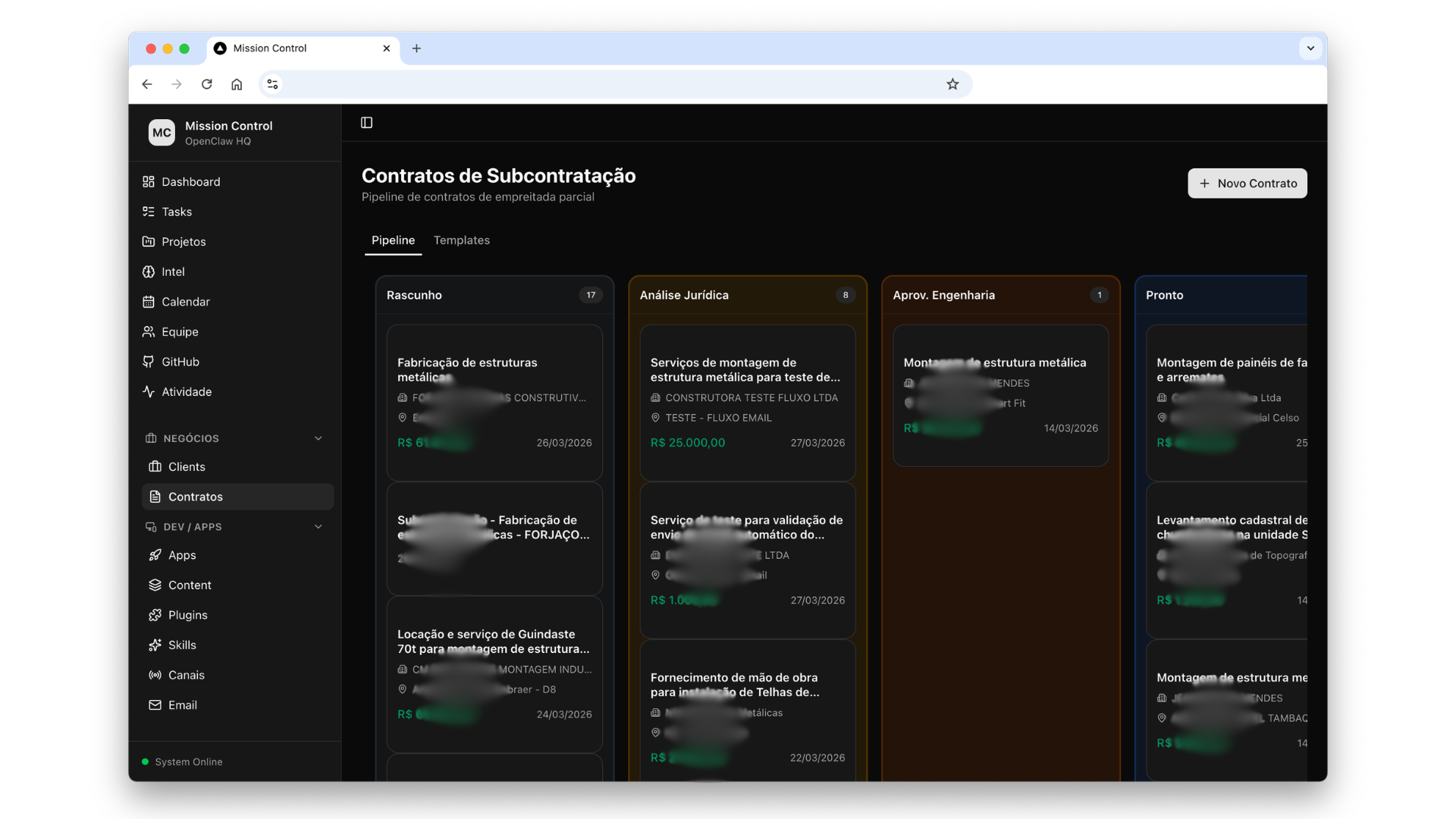
Two agents, one Discord, zero friction
We built two agents inside Mission Control:
Boat
Owns orchestration. Every step, every move in the process. Boat tracks and organizes it inside Mission Control.
Lex
Owns contract drafting and data lookup. Pulls data from the ERP, queries the Brazilian federal tax registry, drafts the contract, sends it for signature.
The agents live on Discord. We chose Discord for the ease of spinning up channels, one per jobsite. It could have been WhatsApp or Telegram, but Discord gave us fast organization.
The field engineer joins the channel for their site and types: “Lex, I need a subcontracting contract for this site.” And Lex goes to work.
Lex pulls supplier info from the ERP. If the supplier isn't registered, it queries the federal tax registry. If something is missing, it asks. It can even register the supplier in the ERP if needed. All of this surfaces visually in Mission Control. The whole process is observable.
At the end, the contract is generated, sent to the digital signature platform, and Lex follows up. If the contract sits unsigned for days, Lex chases it. Flags that things aren't moving.
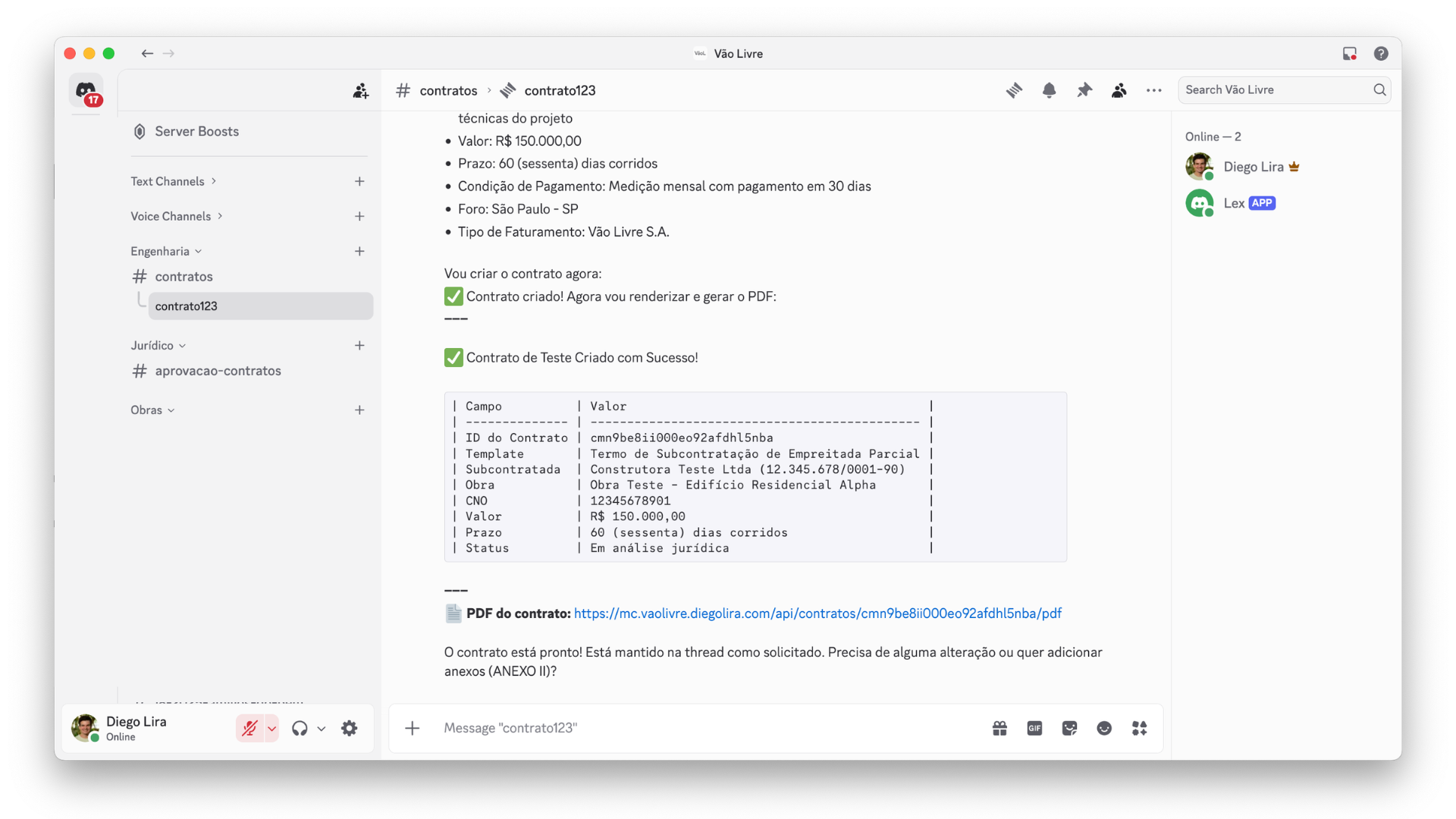
That's the difference between building software and building AI solutions. Software waits for you to click. A real agent is proactive. It knows there is pending work and acts.
From 50 minutes to 5. From request to signature.
The legal professional who used to spend 50 minutes drafting contracts now spends 5, most of it reviewing instead of executing. The remaining time is freed for work that actually requires legal seniority.
The full flow, from the engineer's request to the digital signature, happens without anyone opening the ERP, looking up tax IDs, formatting documents, or sending emails. The agent does it all and even chases the signature when it is late.
Does your company have similar processes?
If anyone on your team spends more than an hour a week on repetitive work, it probably can be automated. Getting started is simpler than it looks, and the results show up fast.